Sunday, November 20, 2016

Mozart's Legacy

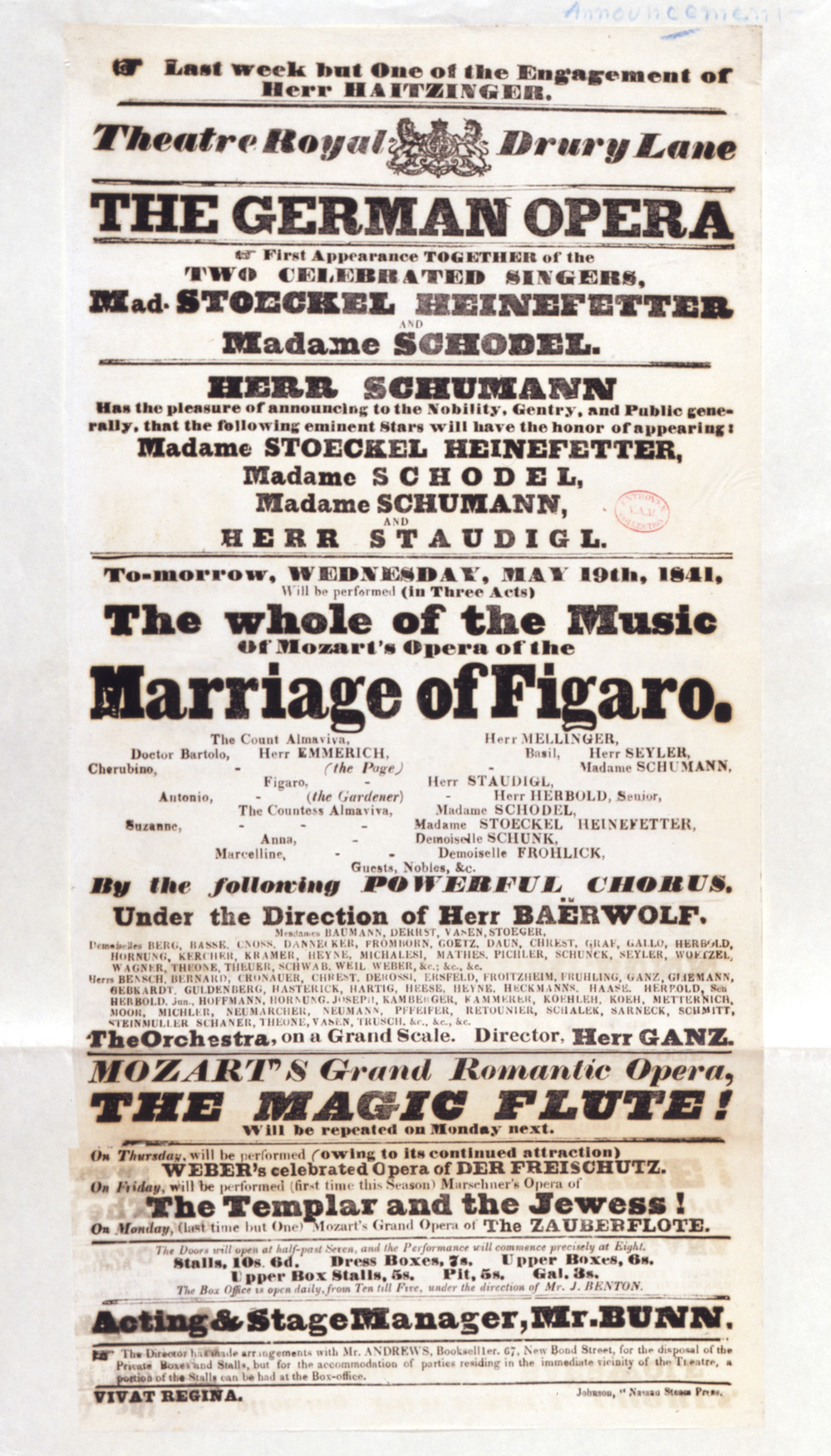
In Mozart’s life, he created over 600 works. From preludes and fugues to operas and symphonies, Mozart wrote them all. Specifically though, Mozart changed the game when it comes to developing the piano concerto, the symphony, and the opera. 


Concertos are pieces for a single instrument or instruments that are accompanied by an orchestra. In the 17th century, concertos were defined as sacred works for voices and orchestra. With this definition, we can kind of imagine what Mozart was thinking when he wrote his concertos. They were something to glorify and highlight. To show all the great things about the instrument, or instruments. In his life, Mozart wrote 27 concertos. Four of them written at the age of 11, during a time when Johann Christian Bach was a great influence to him. Keep in mind that instruments during the baroque period were quite different to the instrument we have today. Mozart most acclaimed concertos, being his piano concertos, were meant to be played on a fortepiano, rather than a pianoforte. The sound would be more muted and not sounding so open. Mozart wrote clarinet concertos and during this time, the clarinet was a newly developed instrument and had yet to show off anything. When we think of clarinets today, they are not as the most pretentious instrument in an orchestra. Nevertheless, Mozart’s concertos are, still to this day, amazing and pieces of greatness. 

Perhaps the best examples of Mozart’s symphonic genius can be attributed to his last three symphonies. These being Mozart Symphonies No. 39, No. 40 and No. 41 which were composed in the year of 1788, three years before his death. Although some may attribute these as his farewell, they are not as Mozart had no idea that in 1791 he would be dead. In fact if he had “lived longer, he would have probably written more symphonies” (Gay 115). What Mozart could have brought to the musical table will be forever unknown but one might assume it would have been extraordinary, bring back the significance of his last three symphonic works. And his final symphony, “Jupiter", had a particular significance with “the repetitions, the cross-references, the themes and their modulations our joys of rare purity; the last movement of the “Jupiter” Symphony concludes with a complicated figure that combines five subjects into a stunning climax” (Gay 117). This fantastic work of art is in no comparison to what was perviously a symphony's purpose — to open a concert rather than be the highlight of a concert. Also, Mozart used multiple musical figures rather than a single melody. Listen to below to hear this particular piece. 


Mozart Symphony No. 41 

However, the ending itself is reflected in works of Haydn, who Mozart knew and was in fact friends with. According to Tom Service, a music writer for the Guardian, “the very same four-note idea used as the basis of a contrapuntal work-out of a symphonic finale” that of Joseph Haydn 1764 13th Symphony. Furthermore, he goes to say the final movement, the “Molto Allegro fuses sonata form with fugue; that’s to say, it fuses the high-watermark of late 18th century practice in instrumental music with the most prestigious, and most compositionally involved, form of counterpoint in earlier music: the fugues of the Baroque, like those by Bach and Handel, that Mozart knew and loved” (Service). Even though many idea in the piece are influenced by pervious composers, what is amazing is the ability to create such masterful musical pieces and make them his own. 

For reference is Haydn 13th below.


In the world of the opera, Mozart had a profound impact. All things considered – he did pass at the age of thirty-five, much sooner than his predecessors who often lived beyond their seventieth year – the magnitude of Mozart’s influence upon the operatic scene is comparable to men like Gluck, Wagner, and Verdi. Mozart’s operas were able to obtain a greater degree of dramatic expression and a stronger human quality than Gluck’s, thus setting the bar for future operas much higher. Prior to Mozart, the majority of operas were centered around themes of “antiquity and mythology, or to the early Christian era.” But Mozart wrote without the restriction of plot or remoteness of character fixed to those themes, and thus his operas featured a warm-hearted, laughter-loving artistic quality that his predecessors lacked. Mozart’s Die Zauberflöte is both tonally simple yet thematically complex. The characters feel like legitimate humans and the theme is often light-hearted and playful. All of Mozart’s operas are rich with amusing incidents amid tragic denouements and jovial yet sinister characters. “In fact it may be said that, in the evolution of opera, Mozart was the first to impart to it a strong human interest with humour playing about it like sunlight". Again, it is necessary to recall that Mozart progressed the opera at least as much as the previous operatic revolutionaries, in less than half the time.


It was Mozart’s great and innate genius that enabled him to develop so intensely so many different forms of musical expression. His revolutionary advances raised the standard for future musical endeavors in all aspects.

Sources


ArtyClassical. "Mozart - Symphony No. 41 in C Major, "Jupiter" - IV. Molto Allegro (Bohm)." YouTube. YouTube, 21 Nov. 2010. Web. 20 Nov. 2016

ComposersbyNumbers. "F.J. Haydn - Hob I:13 - Symphony No. 13 in D Major (Hogwood)." YouTube. YouTube, 11 May 2014. Web. 20 Nov. 2016.

Forye. "Mozart: Concerto for Piano and Orchestra (d-minor) K.466." YouTube. YouTube, 11 Nov. 2012. Web. 20 Nov. 2016.

Gay, Peter. Mozart. New York: Lipper/ Penguin, 2006. 

Merriam-Webster. Merriam-Webster, n.d. Web. 20 Nov. 2016.

Muzikay. "Mozart: Fortepiano Concerto No. 20 in D Minor, K466. Schoonderwoerd, Ensemble Cristofori." YouTube. YouTube, 21 Mar. 2015. Web. 20 Nov. 2016.

Pérez, Antonio Prieto. "Wolfgang Amadeus Mozart "Die Zauberflöte"" YouTube. YouTube, 21 Feb. 2015. Web. 20 Nov. 2016.

Service, Tom. "Symphony Guide: Mozart's 41st ('Jupiter')." The Guardian. Guardian News and Media, 27 May 2014. Web. 20 Nov. 2016.

"Wolfgang Amadeus Mozart and His Operas." Wolfgang Amadeus Mozart and His Operas. Music With Ease, 2016. Web. 20 Nov. 2016.

Credits

Jonna
  • Proofreading 
  • Build Blog 
Chase
  • Bibliography 
  • symphony (why/how complex—compare to previous definition of symphony)
Kailee
  • concerto (compare to previous definition of concerto/types of instruments)
  • intro
Darek

  • opera (compare to previous definitions of opera/historical examples)
  • conclusion

Sunday, November 13, 2016

Patronage Pays

Patronage in the Mid to late 1700s 

During W.A. Mozart’s time, patronage was the most common form of income for musician. The basic idea being that a musician worked—as servants— for commission and produced songs which met the standards of their bosses. Unlike many composers of his time, Mozart had much more freedom and popularity which made him, as he would feel, above a servant. Not as many during that musical period had the advantage. Haydn at age “29 he went to work for Prince Paul Esterhazy, who died and was succeeded in 1762 by his brother Nikolaus, a passionate music lover. 

Below is a painting  of Haydn by Thomas Hardy.  


Below is a painting of Haydn conducting a string quartet. 


Haydn spent nearly 30 years presiding over the musical activities at the prince’s palace 30 miles outside Vienna, as well as at the summer residence over the border in Hungary” (Tommasini). Often, however, the workload could be immense. Though perfect for Haydn, the time consumption and demands of he tenure could be outrageous. A steady job was perhaps the only benefit of such a workload but “nevertheless, the heavy workload of nearly 3 decades was taking it's toll, especially after the death of princess Maria Elizabeth Nikolaus”(Stapert). He did have the ability for much creativity, whereas others may not have had. That is to say, music lovers, such as Nikolaus, allowed for his compositions to be more bold and impressive. Because of the workload and often times restrictions placed upon composers, those who could survive without patronage did. This being shown as Haydn's "feeling of a insulation was growing stronger. He express[es] that feeling with uncommon openness in letters to Maria Anna Von Genzinger, …[where] so much of the year, opportunities to visit the Genzinger home we're limited…and [he] complain[s] about his unremitting work schedule”(Stapert) Thus, Vienna, where Mozart later lived a worked, became hot spot for musical creativity. By the 1820s, patronage faded away in to the past and musician were no longer servants as they once were. Now they were free to be freelance artists and becoming much more of what we think of musicians and composers as today.


Patronage in Modern Times


When you think of the word “Patronage,” you usually think of an organization that provides support for the arts in the form of money. What patronage is, “the support of encouragement, privilege, or financial aid that an organization or individual bestows to another.” Meaning, patronage can come in any form that is some kind of support for whoever they are sponsoring. Patronage back in the days of Mozart has changed. This essay will highlight these differences to bring into light the obstacles that Mozart had. 

The word “patronage” is not really used commonly now days. Most people know the word, but it is hardly ever used in modern conversations. “Sponsorship,” is what can be called the disguise of patronage. Sponsorship is similar, but just more of a common term for it. Sponsors are “a people or organizations that provide funds for a project or activity carried out by another, in particular, or a person who introduces and supports a proposal for legislation.” Sponsorships do not only apply to money, but can also be items. In terms of music and musical groups, sponsors will donate the instruments and sorts in exchange for advertisement. Sponsors now days are just looking for a way to bring more income in, so the authentic feeling of supporting whatever cause is not there. The arts and sports for example. Sponsors will look for the most promising individual or group and will put in money to help them, but those individuals or groups will have to at one point in any public event, mention their sponsors.

In Mozart’s time, patronage was often the primary fuel for professional artists. There simply was, it was believed, not enough money to be made as a freelancer. Certainly, this seemed the most true for sculptors and painters and playwrights, but for musicians as well, whose work was commonly used strictly as background entertainment for parties and gatherings, patronage was perceived with good reason to be the only way for artists and their families to survive. This contrasts with the position of contemporary artists, who are almost entirely freelancers. A handful may commonly deal with museums, making the museums modern patrons, but most deal their art directly with consumers. This is entirely true for musicians. Because live shows are so much more entertaining and bring in significantly greater profits than recorded tracks, musicians often travel to perform for large audiences across the world, as opposed to being “insulated” with an exclusive, “unremitting work schedule.”
However, as a result of musicians being unlikely to settle down while actively performing music, patrons have turned to sponsors. Where patrons were restrictive in where their subjects could perform, sponsors often don’t assume any freedoms from those they sponsor. Patrons were usually wealthy aristocrats, dukes, and princes, whereas sponsors are often businesses and corporations. The shift has gone from individual benefactors who offer their patronage to support the advancement of the arts to large businesses whose contributions are strategically aimed to broaden their brand recognition and encourage future profit. The transition from patronage to sponsorship has reformed the art industries, but it has brought with it a profit-oriented mindset akin to the rise of individualism and capitalism.


Sources

Gay, Peter. Mozart. New York: Lipper/Viking Book, 1999.

Hardy, Thomas. Portrait of Joseph Haydn. 1791. Royal College of Music, London.

Anonymous. Joseph Haydn Playing Quartets. Pre 1790. Vienna Museum, Austria.

Stapert, Calvin. Playing before the Lord: The Life and Work of Joseph Haydn. Grand Rapids, MI: William B. Eerdmans, 2014.

Tommasini, Anthony. "The Big 4 Of Vienna: One Faces Elimination." The New York Times. The New York Times, 10 Jan. 2011. Web. 12 Nov. 2016.

Credits

Jonna
  • Proofreading 
  • Build Blog 
Chase
  • Bibliography
  • Then 
Kailee
  • Now
  • Intro
Darek
  • Compare and Contrast 
  • Conclusion 

Sunday, November 6, 2016

TheBomb.com

What is the "Bomb" in Trinidad Traditions?

The “Bomb,” was a steel pan competition that was very popular during the 1950s to 1960s. The competition has now diminished and there are some resources that describe the “bomb” as a classification of steel pan genre. In chapter five of Shannon Dudley’s book, Carnival Music in Trinidad, he explains “[the] Bomb grew out of musical rivalries in which steelbands attempted to outdo one another with performances of foreign songs set in calypso rhythm” (pg 78). Steelbands would play a lot of Latin music, but later they began to adapt classical music. There were some controversies regarding adapting classical music to calypso music during this time. Calypso music tends to be in duple meter, but there were some pieces that were in triple meter and steelbands would transpose those triple meter pieces into duple meter to get that calypso feel. Some thought that this action was ridiculing the original composer or there were comments that this was not “Trinidadian” and that it did not fit the cultural aspect of Carnival. The tradition of the Bomb integrating classical foreign music with calypso shaped steelband repertoire and how people viewed Panorama and other steelband competitions that formed in the 1960's. 


 In this example, the performer performs Beethoven’s “Fur Elsie,” but changes the rhythm to a more Calypso rhythm.

       The “bomb” origins are reflected the performance of the steel drums during carnival. Fierce competition led to the excellence of the players and acceleration of steel pans as a national instrument for Trinidad and Tobago rather than just an outlet for national music. The bomb — which allowed for the more competitive players to show off their skills — created a safe outlet for Trinidadians to compete. Time consuming as it is, “bomb” players have to secretly practice to create a “WOW” factor for the audience. Pieces must be recognizable, which is of course an important feature not to be forgotten, because it is basis for the fierce competition. If a song is not recognizable, it has less of an impact for the listener. In the beginning, classical pieces allowed for the audiences to be amazed at what may be called the complexity of these “bomb” works.  In its heyday, the “bomb” would take these pieces so they could be danced to instead of the European way where a performance was in large sitting only venues.

In an essay by Shannon Dudley entitled “Creativity and Politics in the Steelband Music of Ray Holman, 1959 — 1972”, he quotes Ray Holman on the important role of danceability. Holman states that  "There was a great respect for classical music. So if a band play that in the road, it used to sound nice. You know this tune, and you could dance to it; because in the Queens Hall you can't dance to it. So the same nice tune, the same nice melody and chords, you're getting it that you could dance. And Trinidadians love to dance. So it was more appreciated.” American jazz tunes could be included in this too not just of the classical variety. Songs like Nat “King” Cole’s “Unforgettable” are even played. Here below is an example.


The “bomb” allowed for musical competitiveness to become a huge part of Trinidad’s Carnival season. Players could and still do use the historic need to fight for what is theirs. From the long fight for independence to the stiff competition is ‘bomb’ performances, the spirit of Trinidadians is reflected in each pieces rendition of a tune. 

The fierceness of the Bomb inspired a competition rife with cunning and surprise. The transformations of classical music into the calypso style for the road in attempts to upstage the next band on Carnival Monday grew out of musical rivalries between steelbands. Much like those rivalries that fueled warriors like Fisheye, a character from Earl Lovelace’s The Dragon Can’t Dance, these competitions were incendiary and there were many opportunities for sabotage and combat between nemeses. To prevent this and therefore evoke greater awe and surprise on the road, bands would rehearse in secret. Fisheye was always looking for a fight, and was only in a band because it sated his appetite for combat. He desired to feel like a warrior, a gladiator, a champion against an enemy band. In a similar way, steelbands would work to drop the greatest bomb and would only rehearse privately and competitively to feel as the superior band the moment their bomb was better than their rival’s. The sparring of a steelband battle is like the dropping of a bomb on Monday. Philo, too, would write down his thoughts for his calypsos in order to gain the upper hand when he performed. If he could inspire greater awe and surprise than his competitors than he would feel superior, as if he had just dropped a bomb himself.

Credits

Jonna
  • Proofreading 
  • Build Blog 
Chase
  • Bibliography
  • What does it mean? Why do we care?
Kailee
  • What is it? History?
Darek
  • Tie To the novel
  • What would the characters think/feel about “The Bomb”

Sources

Dudley, Shannon. Carnival Music in Trinidad: Experiencing Music, Expressing Culture. New  York: Oxford UP, 2004.


Dudley, Shannon. "Creativity and Politics in the Steelband Music of Ray Holman, 1959 —  1972." Ed. Phillip P. Scher. Trinidad Carnival: The Cultural Politics of a Transnational  Festival. Ed. Garth L. Green. Bloomington: Indiana UP, 2007. 161-77.

Lovelace, Earl. The Dragon Can't Dance: A Novel. New York: Persea, 1998.

Noel4729. "Island Rhythms Steel Drum & Calypso Band. Performing Beethoven's Fur Elise."  YouTube. YouTube, 26 June 2014. Web. 06 Nov. 2016.

Panoridim. "Unforgettable [Bomb Style Steelpan Cover]." YouTube. YouTube, 24 Jan. 2009.  Web. 06 Nov. 2016.

Sunday, October 30, 2016

A Changing Venue

         The calypso tents, venues for entertainment such as social commentary and double entendres, have been one of the two most infamous aspects of carnival. Even though it may sometimes seem less important to modern carnival attendees than "Road" entertainment, it has held a significance part in the culture of carnival. In Shannon Dudley's Carnival Music in Trinidad, the growth from "temporary structures erected carnival" became "theaters and auditoriums in Port of Spain". There importance will be discussed and what magic that happens inside them will be revealed. 

History Of Calypso Tents 


By the turn of the twentieth century, Carnival’s tents had become a staple of social commentary. A place for enjoyment and a venue for the calypsonians to perform in, tents started to form in the early 1900's. The more established bands began to create areas out of cocoyea branches and bamboo poles for performers to make costumes and practice dances for Carnival. About a decade later, these “tents” became a more popular area to perform. Also, it allowed performers to charge audience members for admittance. Peter Mason, a writer for the guardian and professor at the University of the West Indies in Jamaica,  goes into depth about the subject saying in “1921, thanks to calypsonians such as Inventor and Lord Executor, the tents had become so popular that Walter ‘Railway’ Douglas, a first world war veteran and calypsonian, was able to open a much more salubrious tarpaulin-covered venue in Port of Spain’s Duncan Street, with seats, a capacity of 300…proper stage…and an entrance fee.”  
        This was a beginning of the more permanent auditorium like tents, evolving past the original bamboo models. Like the term “trunk” on cars, tents continued to be known as tents even though they are a far cry from what they were. These new structures allowed for electricity and stages which were quite an upgrade from a roped off areas in the dirt.  


        Above is a picture of “The Original Old Brigade” tent. (Ermit) This photo is a great example of what tents would have looked like before the Second World War and in comparison to what they look like now is astonishing. Below is a picture of the NAPA (National Academy for the Performing Arts) named after Lord Kitchener, the famed calypsonian.


The venues for calypsonian tents have changed greatly from the introduction of the tents in the 1910s. When the tents first began, calypso was sung in temporary structures erected just for carnival. These structures were often industrial tents, large enough to house both a full stage and many seats for the audience.


Calypso performance in a club.
Calypso performance in an amphitheater.
                                          
Calypso performance in a traditional tent. 

Over time, the locations of most tents have changed from short-term tents to theaters and auditoriums, often in Port of Spain. Each has a stage, but designs vary from clubs (https://youtu.be/RUNVNN0KIak) to amphitheaters (https://youtu.be/b_cKXw7O36s). Some venues, however, still prefer the traditional style of a calypso tent (https://youtu.be/NuFZ3LAn0C8). The style and mood of each venue, interestingly, has little to do with the calypsonians who perform there. The popular tents, which have exclusive performing contracts, often issue them not to those calypsonians whose style matches the  mood of their tent, but to the performers that will help them draw the largest audience. Upbeat and festive artists will be contracted by club-style tents just as likely as amphitheaters and other open tents, and the same goes for calypsonians that are more serious, speaking about social issues and politics. This is a stark contrast to the spirit of American performance halls, where the venue usually limits the type of performance it will have: American clubs often feature jazz ensembles and artists, while amphitheaters will typically host rock and pop bands.


Modern Soca

           Modern Soca music is much different than how it used to be in the past. Soca music in the tent used to be more subtle and light, but now music is more upbeat and jumpy. Traditionally tent music has been more light and intimate, but in recent years has moved to being louder. There used to be live bands, back up singers, and fewer extravagant effects. With modern technology, performers are able to enhance their sets. The bands are now intermixed with recordings or DJs. Artist have back up dancers, flashy lights, and special effects to make their performance have more of an impact. There are uses of things such as pyrotechnics, acrobats, strobe lights, and more.  In the two videos here, you can see that the screen in the back is showing the lyrics to what the artist is singing. We can appreciate the music more because is involves even more audience participation. 


Credits 

Jonna
  • Proofreading 
  • Build Blog 
Chase
  • Bibliography
  • History 
Kailee
  • Modern Usage 
Derek

  • Logistics

Dudley, Shannon. Carnival Music in Trinidad: Experiencing Music, Expressing Culture. New York: Oxford UP, 2004. 

Emrit, Ronald C. "Calypso 1900 - 1949." Calypso (Trinidad). Best of Trinidad, 2015. Web. 30 Oct. 2016.

Mason, Peter. Bacchanal!: The Carnival Culture of Trinidad. London: Latin America Bureau, 1998. 

NH Productions TT. "Machel Montano | Power Soca Monarch Finals 2015 Performance & Winner | HD VIDEO." YouTube. YouTube, 14 Feb. 2015. Web. 30 Oct. 2016.

NHProductionsTT. "Voice - Cheers To Life ( LIVE ) | International Soca Monarch 2016 [ NH PRODUCTIONS TT ]." YouTube. YouTube, 07 Feb. 2016. Web. 30 Oct. 2016.

Roxanne7638. "Kaiso Nobby - Marriage Advice - Calypso Showcase Tent Carnival 2016." YouTube. YouTube, 13 Jan. 2016. Web. 30 Oct. 2016.

StephaniiChase. "Headliners Calypso Tent 2013 Adrian Green Spirit Of The African." YouTube. YouTube, 28 June 2013. Web. 30 Oct. 2016.

"The Lord Kitchener (Aldwyn Roberts) Auditorium - National Academy for the Performing Arts." NAPA. N.p., 2015. Web. 30 Oct. 2016.

Sunday, October 16, 2016

"Once More Once", Jazz Structure

                                   
             As noted by Bonnie C. Wade, "jazz, which is generally characterized by improvisation...is a set of chord of chord changes"(pg 136). This brings us to the structure of jazz which can be broad. Two large formations of jazz instrumentation would be combos and big bands which will be discussed as well as the importance of improvisation. 

Is Improvisation Composing?

            The most crucial reason we use structure is to give music meaning, transforming it from random chords and rhythms to something that is full of emotion and of importance. It is the framework on which the fundamentals of music are hung. It is a way to organize sound in a intensional and inspirational way.              

            In jazz music, improvisation is a key feature. A common definition is the process of making up music “on the fly”, or during a performance. However, Wade describes it more  specifically as “a compositional process in which a musician exercises relatively great flexibility with given material during a performance” (pg 135). This contradicts the preconceived notion that improvisation is just a musician doing “whatever they want”. In reality, a musician is composing on the spot based off of some predetermined material. Usually in jazz it is some type of chord progression, like 12 bar blues.  


             Another great distinction is that a lot of improvisation is practiced in advance. A common practice in the study of jazz is learning a large collection of “licks” or musical quotes that can then be arranged almost automatically from memory during an improvisational solo. Jazz music ahas a long history of learning and stealing musical ideas from other artists. Therefore making improv resemble composition than most people assume. The artist is making a careful selection of musical ideas in order to fit the needs of the particular tune they are performing. 


               The biggest difference between improvisation and composition is the amount of time you have to do it. Where as a composer might rewrite a phrase hundreds of times, an improviser writes as he goes and can judge the music instantly based off of the reaction of the audience. 

                                       Big Band Structure 

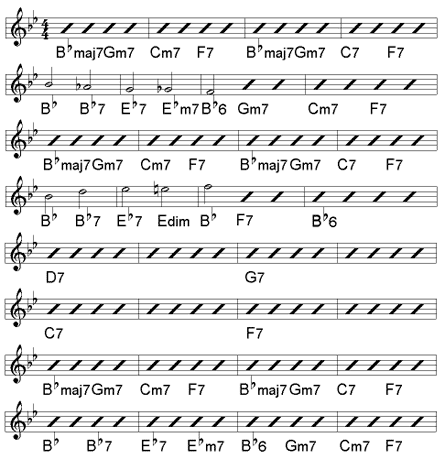
             Jazz, in my firm believe, wouldn't be jazz without the big bands. From the 1920s, big bands dominated western pop culture. They remained apart of mainstream culture even until the 1950s when rock and roll became a staple of the American musical diet. Big bands typically consisted of saxophone, trumpet, trombone and rhythm sections sections. Often, there were singers who would accompany the band. Other instruments, such as the clarinet, frequently were associated with big band acts. Leaders of bands included Benny Goodman, Glenn Miller, Duke Ellington, Count Basie and many more. However, big bands could often have different structures but some were quite common. One of which would be rhythm changes — the chord progression to “I Got Rhythm”. 


“I Got Rhythm” sung by Ethel Merman, 

https://www.youtube.com/watch?v=v4hI-xhGZug

Here is an example of it: 

Many songs used this structure, such as Duke Ellington’s “Cotton Tail.” Often, many pieces would have the same chord progressions as others. 

A popular big band chart, “How High The Moon” has the same progression as “Ornithology” by Charlie Parker. Though different songs, they do share quite a lot. 
Below is Count Basie playing “How High the Moon” 

This below is Charlie Parker preforming “Ornithology” 


However, during a piece, solo and soli parts are often written in. A great deal of “Sing Sing Sing” by Benny Goodman are solos. Often, solos are able to make a song last longer and thus less songs have to be preformed. Big Bands are often played as dance music and having solos can really make a song last like in “Sing Sing Sing”. Below is the piece, and listen for the extensive solos by multiple instruments. 


                                            Jazz Combos


So beginning with basic Jazz structure, most Jazz is built on a predetermined set of chords, which accompanies the melody. When you play through these set of predetermined chords once, it is called a chorus. The main structure of Jazz combo is the repetition of these choruses with something different in each one. The first chorus has the main melody, or the head, which is actually written in. In the next how many choruses, however long the current soloist decides to take, will play their solo. When the current soloist is finished, they will taper and signal for the next performer, who wants a go at a solo, to begin their solo. They will keep doing this until everyone who wanted to do a solo had a chance to. The audience will applaud after each solo to acknowledge them, but to also acknowledge what they just improvised. When all the solos are finished, the band will play the first chorus, or the head, again. For groups of about 10 or more, music is written out to keep the band organized. There is just so many members that it will be really difficult to let everybody have a solo. A way that Jazz combo is described is like a sandwich. You have the bread at both ends, but in the middle is all the different ingredients. 

             Overall, Jazz has many different structures that can make each song style unique. However, they're in many ways alike. Styles are often transitioned from on group to another but can have the similar or even same structure as one another. In the end, there is much that can be discussed, but an ending must come. 

Tasks


Chase
- Blog Builder 
- Big Band Section
- Intro and Conclusion 
Jonna
- Proof Reader
- Improv Section
Kailee
- Combo Section
- Bibliography

Bibliography

OnlyJazzHQ. "Benny Goodman - Sing Sing Sing." YouTube. YouTube, 05 Feb. 2013. Web. 16 Oct. 2016.


JazzBreakTV. "Count Basie - April In Paris." YouTube. YouTube, 04 Feb. 2012. Web. 17 Oct. 2016.

Budoroom. "Count Basie :How High The Moon." YouTube. YouTube, 24 Oct. 2010. Web. 16 Oct. 2016.

TheHellzapoppin. "Duke Ellington - Cotton Tail." YouTube. YouTube, 01 Aug. 2011. Web. 16 Oct. 2016.

Ashtonjoliet. "Ethel Merman Sings I Got Rhythm 1956." YouTube. YouTube, 14 June 2011. Web. 16 Oct. 2016.

Jalcjazzacademy. "Exploring Improvisation in Jazz." YouTube. YouTube, 06 Oct. 2015. Web. 17 Oct. 2016.

Petethomasmusic. "I Got Rhythm Chord Changes." Taming The Saxophone. N.p., 2013. Web. 16 Oct. 2016.

"Musical Elements." Jazz in America. N.p., 16 Oct. 2016. Web. 16 Oct. 2016.

Pvelectric. "ORNITHOLOGY 1- CHARLIE PARKER." YouTube. YouTube, 21 Jan. 2010. Web. 16 Oct. 2016.


Jalcjazzacademy. "Jazz Fundamentals: What Is Improvisation?" YouTube. YouTube, 22 Feb. 2015. Web. 17 Oct. 2016.

Wade, Bonnie C. Thinking Musically: Experiencing Music, Expressing Culture. New York: Oxford UP, 2009. Print.


Sunday, October 9, 2016

The Devil's Interval


What Is It?


The Tritone: The Devil’s Interval? - TWO MINUTE MUSIC THEORY

Also know as the Devil’s Triad and diabolus in musica, the Devil’s Interval is a flatted or diminished fifth, or an augmented fourth. It is an interval, two pitches being played at the same time, with the prefix “tri” referring to the three whole steps between the two notes. It is directly between the perfect fourth and fifth and therefore divides the octave into two halves. When played, the tritone is very dissonant, meaning it clashes and sounds unresolved. Tritones are also used harmonically in dominant chords. Dominant chords are usually used in jazz music.  

You can create tritones buy counting up from the root note 3 whole steps or 6 half steps. For example, if you start at B you would go B - C - C# - D - D# - E - F 

List of Tritones:
  1. A & D#/Eb
  2. A#/Bb & E
  3. B & F
  4. C & F#/Gb
  5. C#/Db & G
  6. D & Ab/G#


Tritones for Beginners - Lesson 1


The History of Tritones


The notorious “tritone”, once commonly know of the Devil’s interval has had — to say the least — an interesting musical past. During the middle ages, the dissonance of the tritone lead to the belief that it was a devilish interval. Thus is became known as “Diabolus in Musica, or Devil in Music, and [was] expressly forbidden under Church canon law.” (Merrick). The reputation lingered and lingered well into the 18th and 19th century. Still to this day, the tritone is avoided in Catholic sacred music. In a 2006 BBC news article, Finlo Rohrer writes that “Professor John Deathridge, King Edward professor of music at King's College London, says the tritone had been consistently linked to evil. In medieval theology you have to have some way of presenting the devil. Or if someone  in the Roman Catholic Church wanted to portray the crucifixion, it is sometimes used there.”
By the 19th century, composers such as Richard Wagner had taken a tritone, minor 2nd  and a diminished 9th, and put it in an entire chord, to be known as the Tristan chord. This became a turning point in music as the chord is perhaps the demonic to date. In other words, the associations with tritones may still exist but they are no longer banned and used commonly in music. The piece below is an example of Wagner’s piece and his Tristan chord.


To prove the associations with the interval still exist, a satirical article published about Ted Cruz tells his plans to ban the interval, and some. For some entertainment, please read! 


Modern Usage


There are many uses of tritones in modern music, but it is just difficult to pinpoint them out. The tritone gives off this eerie, spooky, creepy feeling in music. It is more commonly found in rock, alternative, and punk, but there are other examples in other genres such as classical and jazz. There are even songs in soundtracks like "Maria" from "West Side Story," "The Simpsons," and "South Park."


For the hard rock and metal fans, Black Sabbath’s song “Black Sabbath” is an entire song revolving around tritones. If there ever was song that exhibits the effects of tritones, it would be this song which has a very creepy overall feel. In the sprit of October, and Halloween just around the corner, this is a great song to add to a holiday themed playlist. 


Here is a list of songs that use tritones:  https://www.uberchord.com/blog/tritone-songs/#Operas-Musicals

The list above tells of different genres tritones are found in. It includes classical, which not what we consider modern in present time.

In modern music that uses tritones, the triton always resolves up to the 5th or down to the 4th. Humans usually look for that consonance, so we resolve up or down to make it feel correct. For example, usually the leading tone, or the seventh, will resolve back to the tonic, or in our cases “do”. In other cases, it gives that eerie or creepy feeling that the composer is trying to convey, or it creates a dissonance that just sounds correct, even though to those who have perfect pitch, it feels like screaming in their ears. 

Sources


"A Brief History of the Devil's Tritone." Mental Floss. N.p., n.d. Web. 08 Oct. 2016. <http://mentalfloss.com/article/77321/brief-history-devils-tritone>.

Homecookedblues. "Tritones for Beginners - Lesson 1." YouTube. YouTube, 22 Aug. 2011. Web. 08 Oct. 2016. <https://www.youtube.com/watch?v=_u9laoGPB_o>.


Odansmith. "The Tristan Chord." YouTube. YouTube, 19 Aug. 2012. Web. 09 Oct. 2016. <https://www.youtube.com/watch?v=gpWg_cZkDho>.

OfficialSabbath. "Black Sabbath - "Black Sabbath"" YouTube. YouTube, 29 Oct. 2014. Web. 09 Oct. 2016.


Schoen-Philbert, Jonas. "25 Songs With The Tritone." Uberchord App Comments. Uberchord, 09 Sept. 2016. Web. 08 Oct. 2016. <https://www.uberchord.com/blog/tritone-songs/#Classical>.

Schoen-Philbert, Jonas. "The Tritone, Everything You Need to Know." Uberchord App The Tritone Everything You Need to Know Comments. Uberchord, 09 Sept. 2016. Web. 08 Oct. 2016. <https://www.uberchord.com/blog/the-tritone/>.

The1564studios. "The Tritone: The Devil's Interval? - TWO MINUTE MUSIC THEORY." YouTube. YouTube, 17 Feb. 2016. Web. 08 Oct. 2016. <https://www.youtube.com/watch?v=wKF-j_3gTKA>.


Credits


Jonna: What is it? Essay, Proofreading
Chase: The History Essay, Bibliography
Kailee: Modern Usage Essay, Build Blog/Post